Case Study: How Flywheel Modernised San Francisco Taxi Dispatch with FLEET
The Challenge San Francisco's taxi industry was in crisis. Once a thriving network of independent operators and cooperatives, the city's taxi fleet...

San Francisco's "Meter and a Half" rule looked simple on paper. Drivers could charge 150% of the metered fare for trips exceeding 15 miles beyond city limits, compensating for the deadhead return on long-distance fares. The rule had been in the books for years. What had changed, at least four or five times depending on who was reading it, was how that 15-mile threshold was being measured.
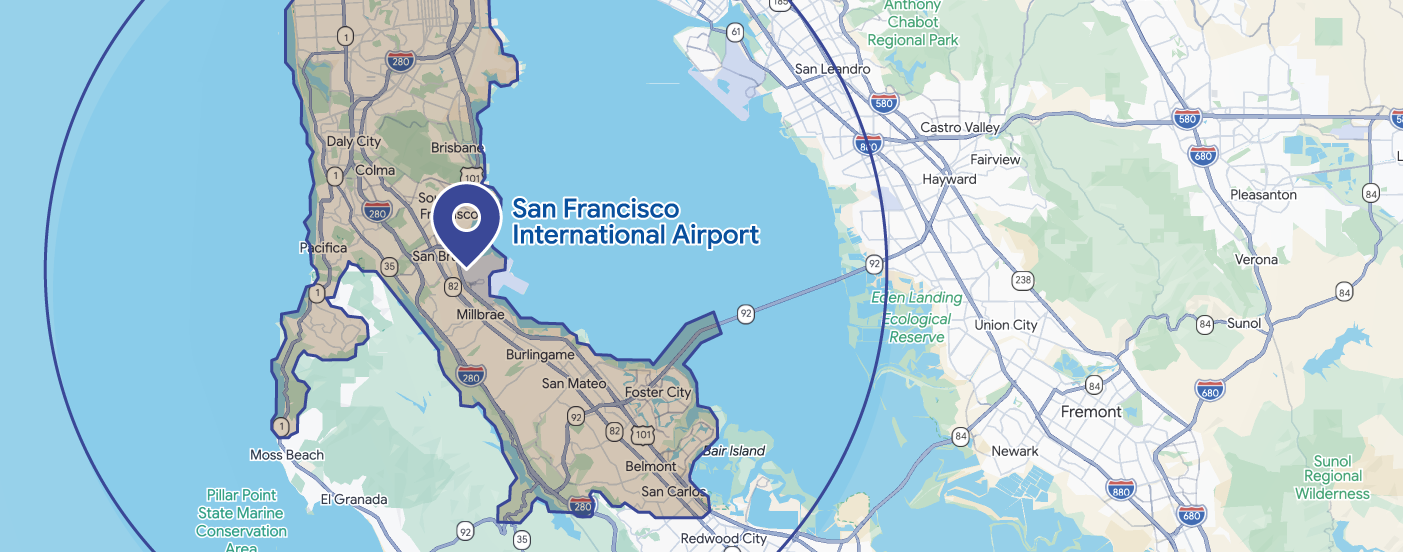
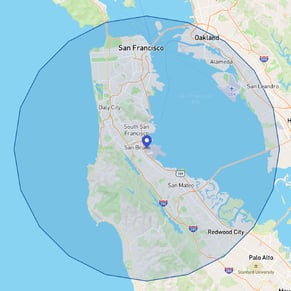
The most recent interpretation, implemented by the SFMTA, measured the threshold as a straight-line radius — published as a circular boundary map, accessible via QR codes placed in every taxi. It was a neat visual. It did not match the road network.
| Location | San Francisco, California |
| Regulator | San Francisco Municipal Transportation Agency (SFMTA) |
| Regulation | Meter and a Half — 150% fare rate for trips exceeding 15 miles beyond city limits |
| Core issue | Boundary map measured straight-line distance; the regulation specified driving miles |
| Resolution | Identified pre-deployment. Corrected maps now in final regulatory approval |
| Driver impact | Estimated 10–15% monthly income increase on affected routes |
San Francisco is surrounded by water and connected by winding coastal roads. A straight-line boundary map does not survive contact with that geography.
A destination 18 driving miles from SFO airport could sit just 12 miles away as the crow flies. Fares that had qualified for the higher rate for years suddenly did not.
FLEET identified the discrepancy before deployment and initiated correspondence with the SFMTA immediately, seeking written clarification on whether the 15-mile threshold referred to driving distance or straight-line distance. After multiple rounds of dialogue, the SFMTA confirmed in writing: driving miles.
That confirmation revealed a gap between the written rule and the published boundary map. The engineering team updated the system's boundary logic to reflect the SFMTA's clarification. With driving miles now accurately calculated, the system began generating GPS-verified trip records for every fare near the threshold: pickup location, drop-off address, the exact route driven, and total driving distance.
The written rule — 15 driving miles from San Francisco International Airport. |
The published boundary map — a straight-line radius, accessible through a QR code in every taxi. |
For three months, the system calculated fares correctly while the QR code in every taxi still displayed the old circular boundary. Complaint volume went from zero to roughly ten drivers per day. By week six, passengers in border communities like Pacifica began calling the city's 311 line, disputing fares that were now 50% higher than they had been for years.
The regulation itself had not changed. The way it was being measured had. Neither drivers, passengers, nor the regulator had the data to see the full picture clearly.
No other fleet raised similar complaints. Other operators used legacy systems where drivers manually applied the surcharge at their own discretion. The automated system removed that ambiguity entirely. When the boundary data was wrong, the error was visible to drivers, passengers, and the regulator alike.
FLEET recorded and shared trip-level data with the SFMTA as passenger and driver complaints continued, providing the regulator with documented evidence that had not previously been available from any fleet in the city. Other operators used manual fare adjustments with no automated tracking, so the SFMTA had no comparable data source except the information FLEET was able to record, verify, and validate.
When the SFMTA queried a specific fare, the trip record pulled directly: the driver's actual route with distance calculated from GPS data. No spreadsheets. No reconstructing the journey after the fact. Consistent every time.
The regulator requested a formal meeting. The team presented two driving-distance boundary maps — one from the city centre, one from the airport — calculated from actual road networks. These were reviewed alongside the SFMTA's own proposed revision, and the collaboration identified remaining inaccuracies in the draft boundaries.
The SFMTA asked the fleet to provide its maps for adoption. Those maps are now in final subcommittee approval.
For drivers: Fares on long-distance routes calculate automatically based on GPS-verified driving distance. Areas excluded by the inaccurate map now qualify for the 150% rate. Estimated monthly income increase on affected routes up to 15%.
"If you just look at airport drivers, their earnings increased 5–7%, from the accuracy of the meter to non-disputes from passengers."
— Mustafa, General Manager
For passengers: Every fare is calculated from the same GPS data. Manual overcharging on routes that do not qualify is removed. Undercharging on routes that do qualify is also removed.
For the regulator: A boundary issue that generated daily complaints is being resolved using GPS-verified data no fleet had previously been able to provide.
When fare calculations are manual, discrepancies stay hidden.
When they are automated, GPS-verified, and logged, problems that persisted for years become solvable in months.
Not adversarial. Not passive. A shared commitment to getting the regulation right.
"The automation of out-of-town trips has been a huge relief for drivers and passengers. Gone is the guesswork of trying to do math after the ride, or the passenger accusing us of stealing. Now FLEET needs to get the SFMTA to change the out-of-town to flat rates per city."
— Mustafa, General Manager
Want to see how FLEET's taximeter and fare calculation work in practice? Explore the Taximeter capability or talk to us about your fleet's regulatory environment.
The Challenge San Francisco's taxi industry was in crisis. Once a thriving network of independent operators and cooperatives, the city's taxi fleet...
The Jean Genie The Jean Genie loves chimney stacks. He's outrageous, he screams and he bawls (Jean Genie). Jean Genie, let yourself go, whoah. Sits...
The Problem: Dead Kilometres and Idle Time In any fleet operation, the most expensive kilometres are the ones without a passenger. Dead-running —...